

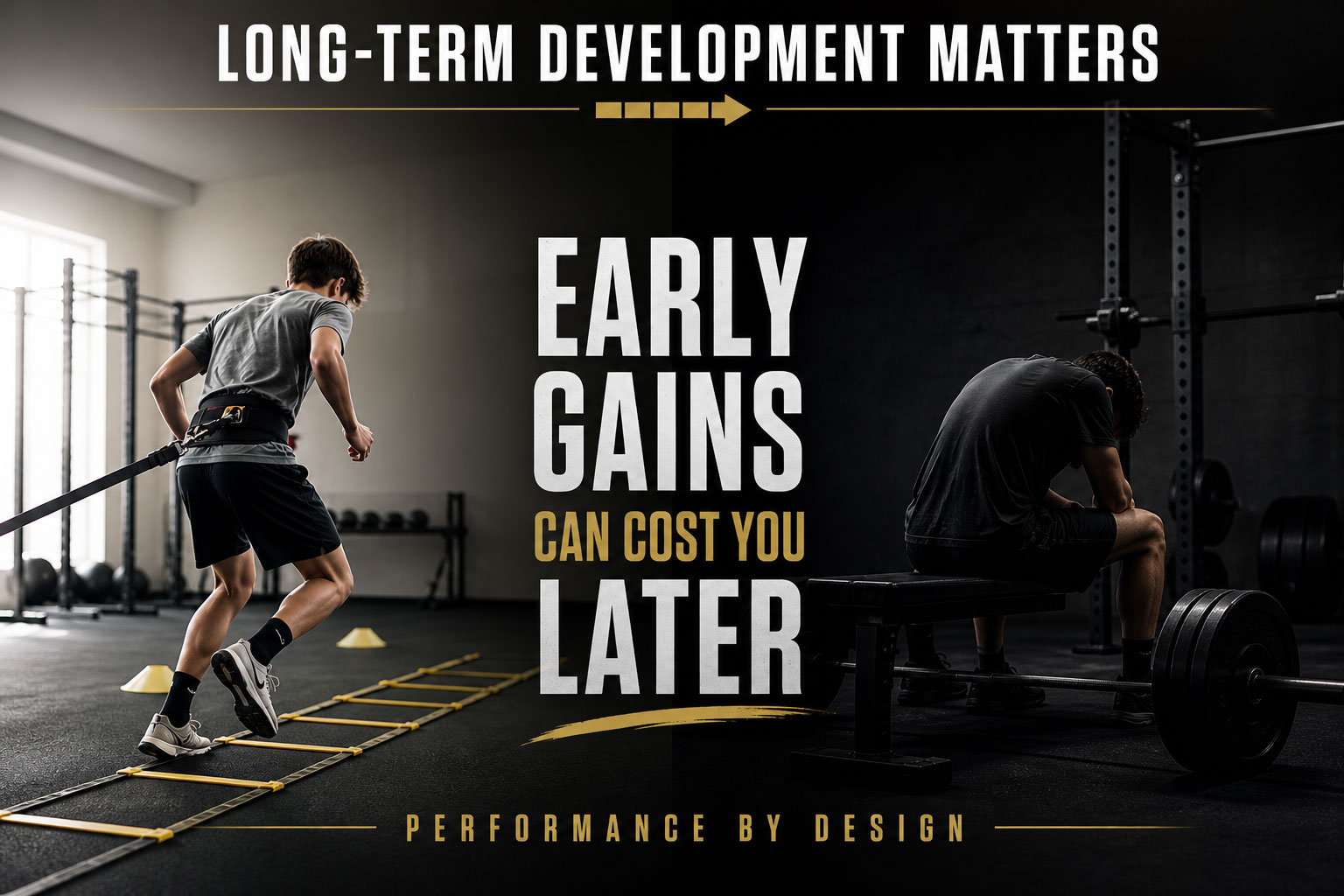
The Illusion of Early Progress
Early success looks convincing.
- Faster gains.
- Stronger numbers.
- Quick improvements.
But what improves early does not always last.
In many cases, the athletes who dominate early are the ones who plateau first.
Where Development Goes Wrong
Modern training often prioritizes short-term results.
Common patterns:
- Early specialization in one sport
- Heavy strength training too soon
- High training intensity without progression
- Competition schedules that replace development
These approaches produce quick improvements.
But they often lead to:
- Early performance ceilings
- Technical limitations
- Increased injury risk
- Long-term stagnation
Research has shown that early specialization can lead to performance peaking as early as ages 15–16, followed by stagnation.
Why Early Intensity Creates Limits
The body adapts to what it experiences most.
When athletes are exposed to excessive intensity too early:
- Movement patterns become rigid
- Neural systems prioritize force over coordination
- Skill development slows
- Adaptability decreases
Heavy strength training, especially early on, can:
- Alter coordination patterns
- Reduce rate of force development in sport-specific movement
- Create inefficient movement habits
These adaptations may improve short-term output — but they can limit long-term potential.
A Better Model for Long-Term Development
Long-term performance is built in layers.
Not through intensity—but through progression.
The most effective development model follows three principles:
- Delay Excessive Intensity
Build movement quality before adding load. - Develop Broad Athletic Capacity
Focus on general movement skills early. - Progress Gradually Over Time
Allow performance to mature, not spike.
Athletes who build correctly may progress slower early—but surpass their peers later.
How to Build Athletes for Long-Term Performance
- Use the Minimum Effective Dose
Don’t chase maximal strength early.
Small, consistent improvements (5–10% annually) are more sustainable and effective long-term.
- Prioritize Movement Before Load
Develop:
- Coordination
- Balance
- Timing
- Rhythm
These qualities create adaptable athletes.
- Build Weaknesses Early, Strengths Later
Early stages:
- Address imbalances
- Build general capacity
Later stages:
- Lean into strengths
- Refine performance output
This creates more complete athletes over time.
- Reduce Over-Competition
Too much competition early limits development.
Athletes need time to:
- Train
- Learn
- Recover
Development requires space—not constant performance.
- Expand Athletic Foundations
Incorporate:
- Sprinting (speed and coordination)
- Gymnastics (body control)
- Swimming (movement through space)
These build a deeper athletic base that supports long-term success.
The Long-Term Standard
Short-term success is easy to chase.
Long-term performance requires discipline.
The goal is not to create the best 15-year-old athlete.
The goal is to build the best 25-year-old athlete.
Structure training accordingly.
Coach-Level Insight
The biggest mistake in physical preparation is solving today’s problem at the expense of tomorrow’s potential.
Ask:
- Are we overloading too early?
- Are we prioritizing results over development?
- Are we building adaptable athletes—or specialized ones?
Long-term development is not accidental.
It is designed. . .
